
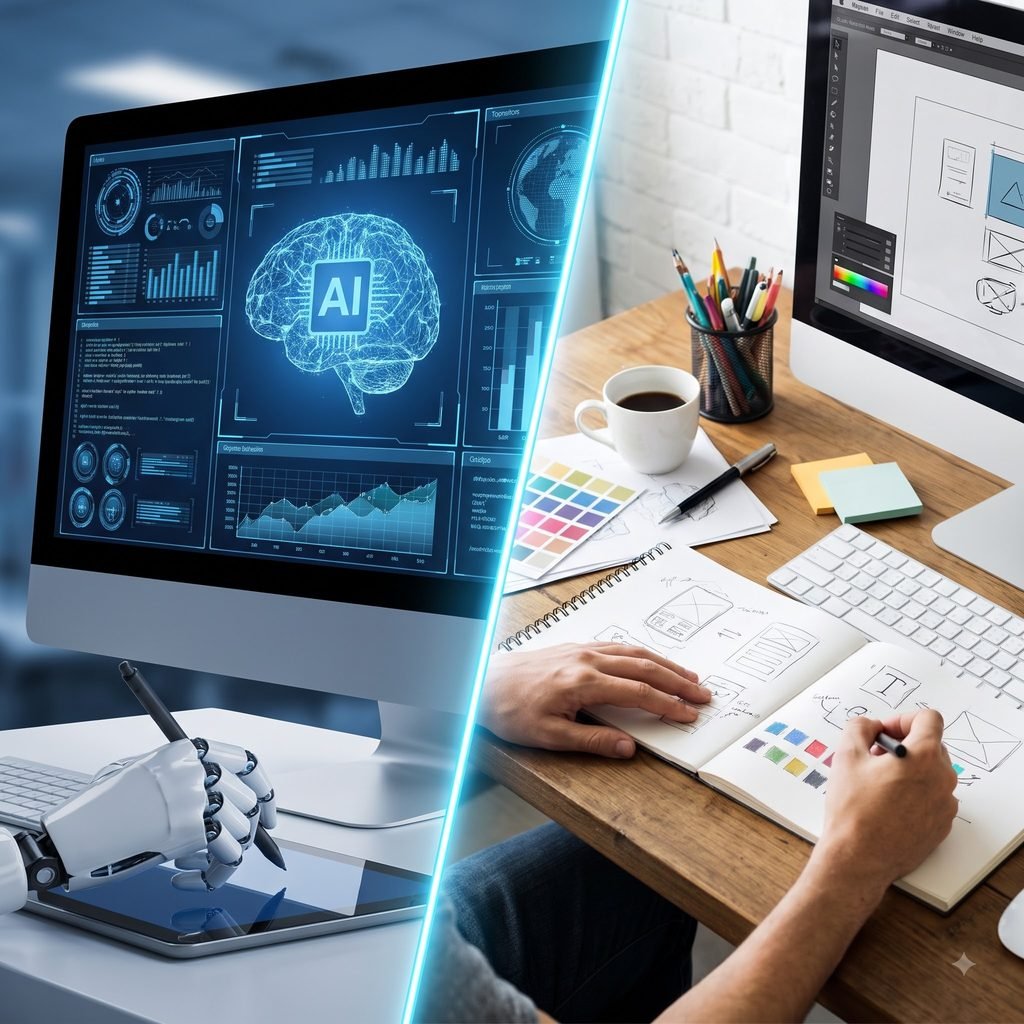
Artificial intelligence has changed the way we work, create, and communicate. From writing content to generating images, editing videos, and creating social media posts, AI tools can now complete tasks that once required hours of manual work.
This naturally raises an important question for businesses, marketers, and creative professionals:
Can AI really replace graphic designers in 2026?
The short answer is: AI can replace some design tasks, but it doesn’t completely replace a professional graphic designer.
Instead, the bigger change is happening in the way designers work.
Today, an AI graphic designer can use artificial intelligence to generate ideas, explore visual concepts, create variations, remove backgrounds, improve images, and speed up repetitive design work. But creating a design that truly understands a business, its customers, its brand personality, and its message still requires human thinking.
The future of graphic design is increasingly becoming a combination of AI technology + human creativity.
Let’s understand why.
What Is AI Graphic Design?
AI graphic design refers to the use of artificial intelligence tools to assist with or automate different parts of the graphic design process.
Modern AI design tools can help generate:
- Social media posts
- Advertisements
- Posters
- Banners
- Product images
- Marketing creatives
- Presentations
- Illustrations
- Logos and brand concepts
- Backgrounds
- Promotional graphics
- Visual content ideas
Instead of starting every design from a blank page, designers can use AI to quickly generate concepts and then refine them according to the actual requirements of a business.
For example, a business may need an Instagram advertisement for a new product.
Traditionally, a designer might spend considerable time researching references, creating concepts, finding suitable images, editing them, and preparing different versions.
With AI-powered graphic design, the designer can explore multiple creative directions much faster.
But generating an image is only one part of the job.
The real challenge is creating a design that communicates the right message to the right audience.
What Can AI Do for Graphic Designers?
AI has become a powerful assistant for designers.
One of its biggest advantages is speed.
A designer can use AI to brainstorm several visual concepts in minutes instead of spending hours developing every idea manually.
1. Generate Creative Ideas
Sometimes the hardest part of designing isn’t opening Photoshop, Illustrator, or another design tool.
It’s deciding:
“What should I actually create?”
AI can help generate different creative directions, layouts, themes, headlines, visual styles, and campaign concepts.
This makes AI particularly useful during the brainstorming stage.
2. Create Visual Concepts
AI image-generation tools can create visual concepts based on text descriptions.
For example:
“Create a premium product advertisement with dramatic lighting, luxury styling, and a clean background.”
A designer can use the generated concept as inspiration or as part of the final creative workflow.
3. Speed Up Image Editing
AI can assist with tasks such as:
- Background removal
- Image enhancement
- Object removal
- Image expansion
- Upscaling
- Retouching
- Color adjustments
These tasks can otherwise take significant manual effort.
4. Create Multiple Design Variations
Businesses rarely need only one design.
A single campaign may require:
- Instagram post
- Facebook creative
- WhatsApp promotional image
- Story design
- YouTube thumbnail
- Website banner
- Print advertisement
AI can help designers adapt and experiment with different versions more efficiently.
So, Can AI Replace Graphic Designers?
This is where things become interesting.
AI can produce impressive visuals, but graphic design is not simply about producing attractive pictures.
Professional graphic design involves understanding:
- Brand identity
- Target audience
- Communication goals
- Typography
- Visual hierarchy
- Layout
- Color psychology
- Marketing objectives
- Customer behaviour
- Brand consistency
Imagine two businesses selling the same product.
Both use an AI tool and generate attractive advertisements.
One advertisement may look beautiful but fail to communicate the product’s actual benefit.
The other may be simpler but clearly communicate:
What the product is, who it is for, why it matters, and what the customer should do next.
The second design may perform better because design is communication, not decoration.
That is where human expertise still matters.
AI vs. Graphic Designer: What’s the Difference?
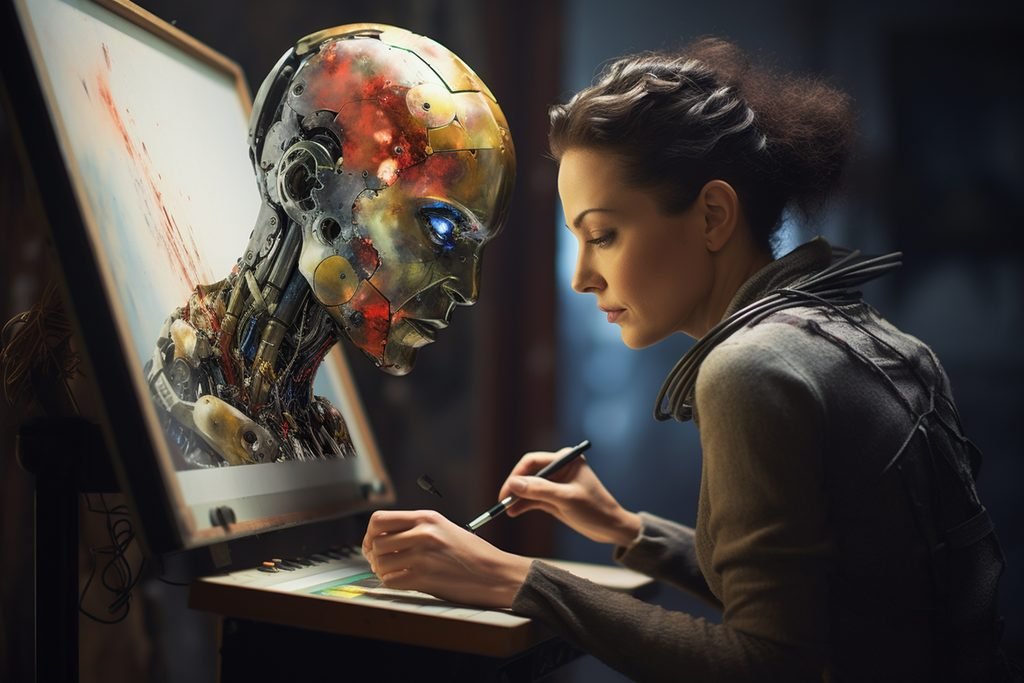
The easiest way to understand the difference is to look at what each is good at.
AI is good at:
- Speed
- Generating ideas
- Creating variations
- Repetitive tasks
- Image manipulation
- Exploring different visual styles
- Assisting with creative brainstorming
Human designers are good at:
- Understanding context
- Understanding a brand
- Making creative decisions
- Communicating emotions
- Understanding customers
- Creating visual strategy
- Maintaining brand consistency
- Knowing when a design feels “right”
- Turning a business objective into a visual message
AI can generate thousands of possibilities.
But someone still needs to decide which possibility actually makes sense for the business.
Why Human Creativity Still Matters in 2026
Technology can generate an image.
But creativity isn’t simply generating something new.
Creativity is knowing what to create and why.
A professional designer doesn’t just ask:
“Does this look good?”
They also ask:
“Does this communicate the message?”
“Will the customer understand it?”
“Does it look like the brand?”
“Will it stand out from competitors?”
“Is the information easy to understand?”
These decisions require experience, observation, communication, and strategic thinking.
That’s why the role of the designer is changing rather than simply disappearing.
The Rise of the AI Graphic Designer
One of the biggest changes in the creative industry is the emergence of the AI graphic designer.
An AI graphic designer isn’t necessarily a replacement for traditional design.
Instead, it can be understood as a designer who combines traditional design skills with modern AI tools.
This combination can make the creative process faster and more flexible.
For example:
Traditional workflow:
Idea → Research → Concept → Design → Editing → Variations → Final Output
AI-assisted workflow:
Idea → AI brainstorming → Concept generation → Human design decisions → Refinement → Brand adaptation → Final Output
The second workflow can save time without removing the human from the creative process.
What Does This Mean for Businesses?
For small businesses, startups, entrepreneurs, and local brands, AI-powered graphic design can be particularly useful.
Businesses constantly need fresh marketing content.
They may need:
- Social media graphics
- Festival creatives
- Promotional banners
- Product advertisements
- Flyers
- Brochures
- Business cards
- Packaging designs
- Website graphics
- Corporate branding
- Digital advertisements
Creating all this content manually can take time.
AI can help accelerate the process.
But businesses shouldn’t focus only on “How quickly can I get a design?”
They should also ask:
“Will this design help my business communicate better?”
That’s the difference between simply generating graphics and using AI graphic design strategically.
AI + Graphic Designer: A Better Combination
Instead of thinking about AI vs graphic designer, perhaps the better question is:
What happens when AI and a graphic designer work together?
That’s where the real opportunity lies.
AI can handle much of the repetitive and exploratory work.
The designer can focus on:
- Creative direction
- Brand strategy
- Storytelling
- Layout
- Visual communication
- Quality control
- Marketing objectives
This creates a more efficient creative workflow.
At Print Café, this approach can be especially valuable for businesses that need both printing and digital design solutions.
A business may need a social media campaign today, a brochure tomorrow, business cards next week, and personalized promotional products later.
Having design, branding, printing, and personalized gifting requirements handled through one place can simplify the process.
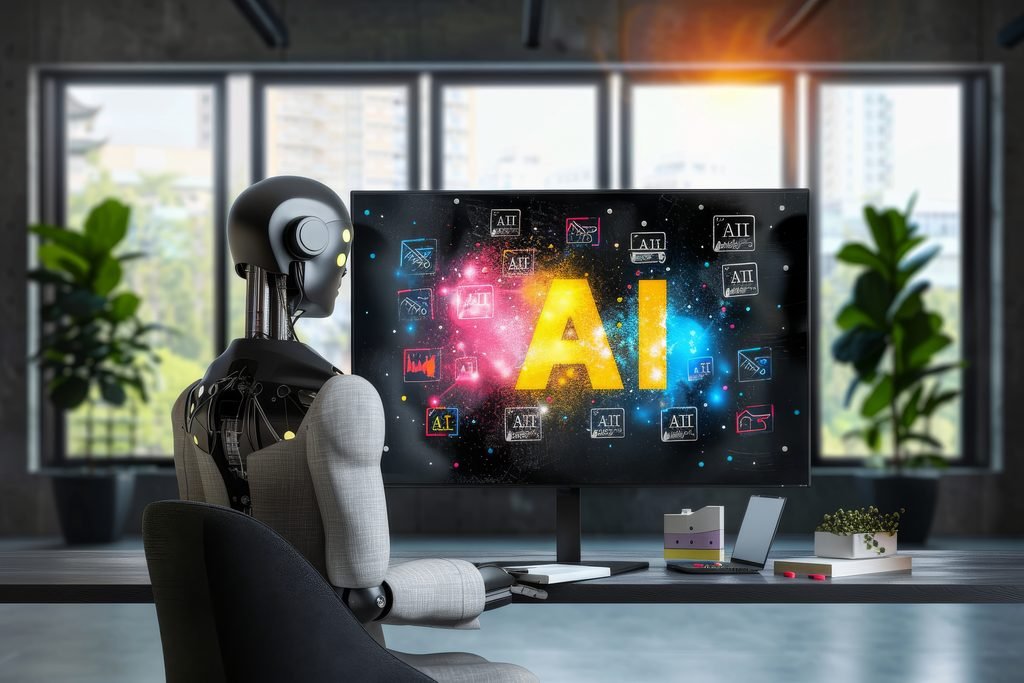
Will Graphic Designers Disappear Because of AI?
Probably not.
But the role of graphic designers is changing.
Designers who rely only on repetitive manual tasks may find that AI can automate some of their work.
At the same time, designers who learn how to use AI effectively can potentially work faster, explore more ideas, and provide more creative value.
The important skill isn’t simply knowing how to use an AI tool.
It’s knowing when to use it, how to guide it, and how to improve the result.
AI is a tool.
Creative thinking is still the driver.
The Future of Graphic Design Is Human + AI
The future probably isn’t about choosing between humans and machines.
It’s about using technology intelligently.
AI can provide speed.
Humans provide direction.
AI can generate possibilities.
Humans make decisions.
AI can automate repetitive work.
Humans bring strategy, emotion, and meaning.
And when these strengths are combined, businesses can create marketing content faster while still maintaining a strong and recognizable brand identity.
So, can artificial intelligence replace graphic designers in 2026?
AI can certainly automate parts of graphic design.
It can change how designers work.
It can reduce the time required for many creative tasks.
But replacing the entire role of a professional graphic designer is a much bigger challenge.
Because great design isn’t just about pixels, fonts, images, or AI prompts.
Great design is about understanding people.
And that’s something businesses will continue to need.
Final Thoughts
The question shouldn’t be:
“AI or graphic designer?”
The more useful question is:
“How can AI and graphic designers work together to create better results?”
For businesses, this shift can mean faster content creation, more creative experimentation, and more efficient marketing workflows.
For designers, it means learning new tools while strengthening the skills that AI cannot easily replace: creative thinking, strategy, communication, storytelling, and understanding the brand.
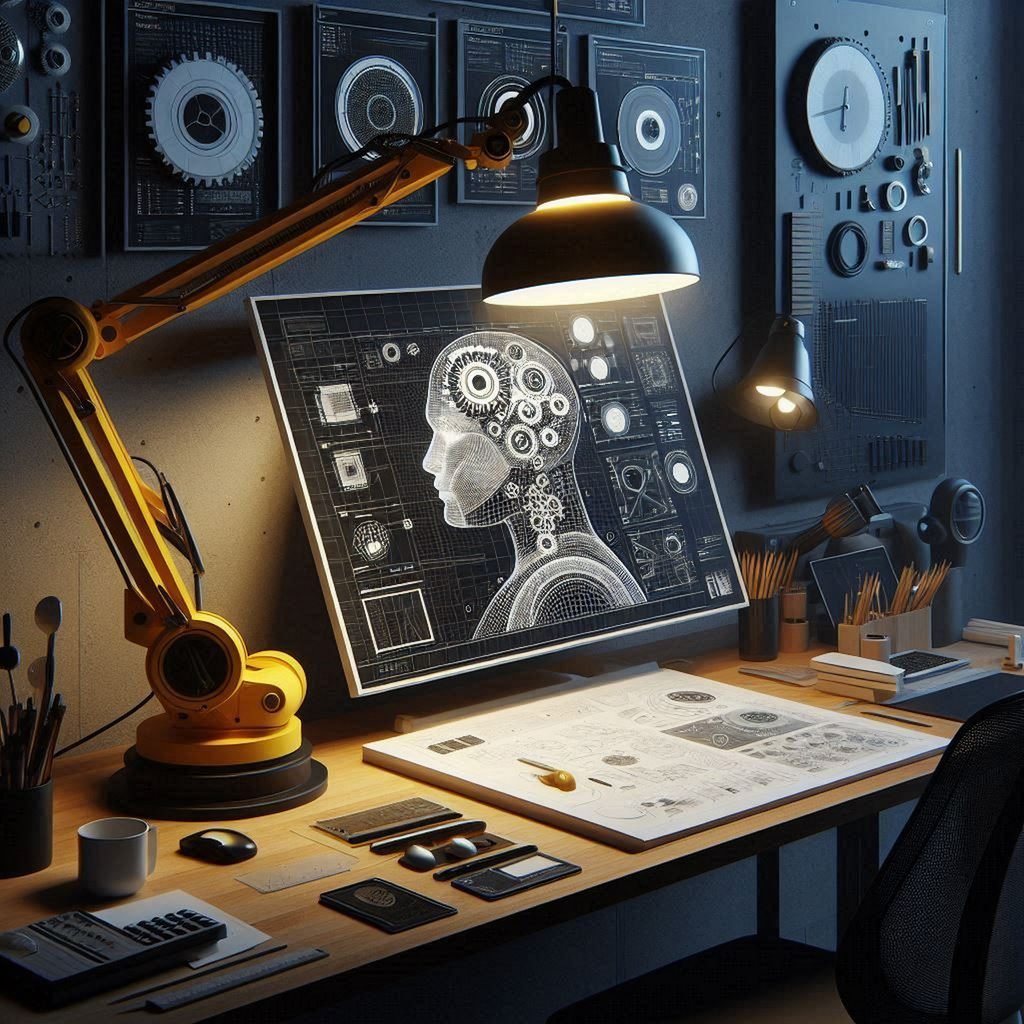
The future of graphic design isn’t necessarily about AI replacing designers.
It is about designers who know how to use AI becoming more capable creative professionals.
And for businesses, that means the most valuable design partner may not be someone who chooses between AI and creativity—but someone who knows how to combine both.